
.svg)


ADHD assessment?
- Dexedrine contains only pure d-amphetamine, while Adderall is a blend of 75% d-amphetamine and 25% l-amphetamine, that difference in composition is why the two medications can feel noticeably different even though both treat ADHD.
- Dexedrine is more potent per milligram than Adderall, so switching between the two always requires a dosage adjustment under provider supervision, for example, 20 mg of Adderall roughly equals 15 mg of Dexedrine.
- Dexedrine tends to suit people who experience jitteriness, anxiety, mood crashes, or overstimulation on Adderall, while Adderall may work better for those who need more physical energy, motivation to start tasks, or simply require a widely available first-line option.
- Neither medication is a weight loss treatment, appetite suppression is a side effect, not a therapeutic goal, and managing it means eating strategically, timing doses carefully, and setting reminders to stay nourished throughout the day.
- The right choice between these two medications comes down to your specific symptom pattern, side effect profile, and how your body responds, factors best worked through with a licensed clinician rather than decided on user reviews alone. Start My Screening
Why Compare Dexedrine and Adderall?
People usually search “Dexedrine vs. Adderall” for one of three reasons:
- Their current medication isn’t working anymore.
- They’re having side effects (or financial costs) they can’t live with.
- They want to understand why one person swears by Dexedrine and another thinks Adderall is the holy grail.
This article is here to help you decide which medication makes it easier for you to function, get things done, and feel like yourself.
Let’s get clear on the facts — and how to apply them to you.
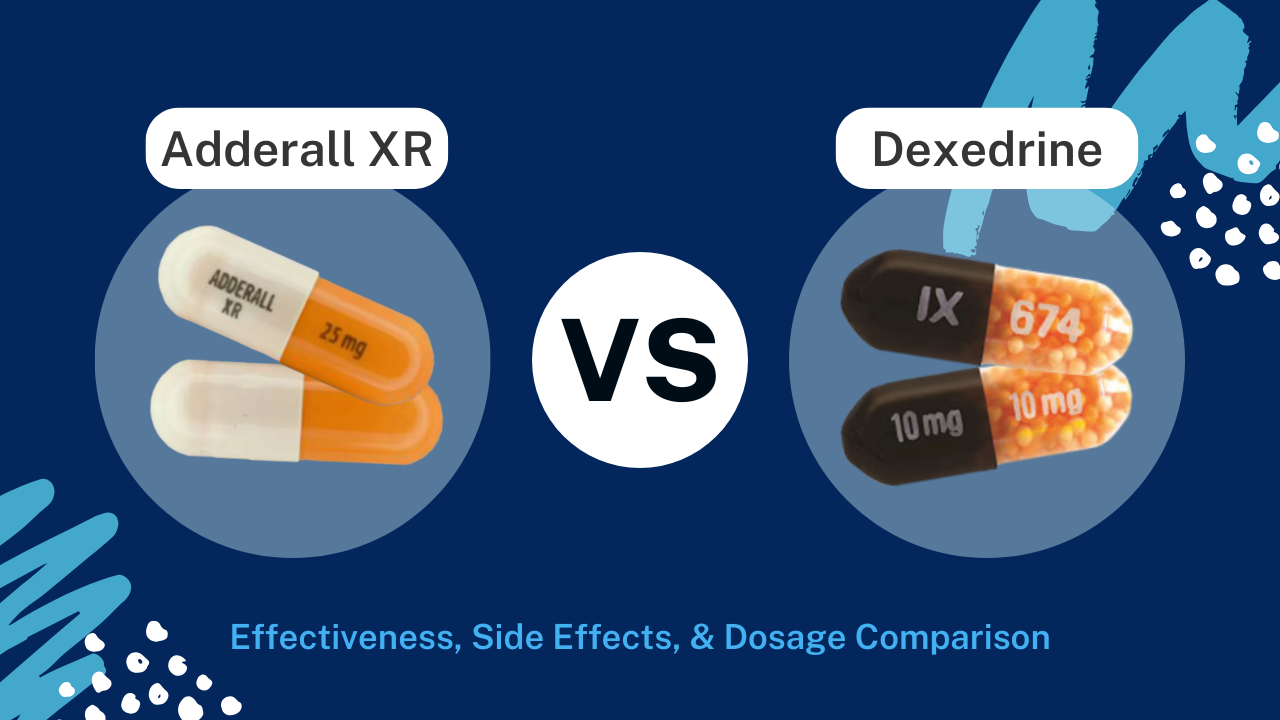
What Is Dexedrine? What Is Adderall?
Think of these two meds like two versions of the same ADHD management tool:
- Both Dexedrine and Adderall are stimulants.
- Both work on dopamine and norepinephrine.
- Both can improve focus, motivation, and follow-through.
But the way they work feels different.
Dexedrine
Dexedrine (dextroamphetamine sulfate) is one of the oldest FDA-approved ADHD medications — and also one of the most precise. It only uses one active form of amphetamine: d-amphetamine. It’s mostly responsible for the focusing, motivating, and task-starting effects of stimulants.
- Active ingredient: Pure dextroamphetamine (d-amphetamine)
- Forms: Immediate-release tablets (IR) and extended-release (ER) Spansules
- Why people choose it: Fewer ingredients, smoother focus, less jitteriness for some
- Why it’s less common: Lower availability, not the first-line option for many prescribers
While Adderall might be a “household name,” Dexedrine can be the “Why didn’t anyone tell me about this sooner?” option.
Adderall
Adderall is a mix of four amphetamines (including d-amphetamine and l-amphetamine). Because l-amphetamine can hit the cardiovascular system a bit hard, you might notice some anxiety or jitteriness (but for some, it’s energizing).
- Active ingredients: 75% dextroamphetamine (d-amphetamine), 25% levoamphetamine (l-amphetamine)
- Forms: Immediate-release (IR) and extended-release (XR)
- Why people choose it: First-line option, widely available, good insurance coverage
- Why some avoid it: Mood crashes, appetite suppression, anxiety from the l-amphetamine component
Dexedrine vs. Adderall: Key Differences
Here’s a look at the basic comparisons between the two:
How to Apply This to Real Life
If you identify with any of the following, let your prescribing clinician know so they can make an informed decision about which med is best for you:
- You get jittery, tense, or “amped up” easily
- Stimulants make your heart race or your thoughts speed up
- You get hard crashes or emotional swings by the afternoons on Adderall
These could be signs that Dexedrine may feel smoother and less anxiety-provoking. However, Adderall can work if:
- You feel “underpowered” on stimulants and need more physical energy
- Motivation is hard — you can concentrate once you start, but starting is the hard part
- You need consistent pharmacy access and insurance coverage
Dexedrine vs. Adderall Dosage Conversion Chart
If you’re switching meds, keep in mind that Dexedrine is more potent per mg. It only has the one active d-amphetamine isomer, so it’s not a blend like Adderall. Your clinician should adjust the dosage, but expect it to be smaller if you’re going from Adderall to Dexedrine.
Here’s the approximate conversion:
Important Notes on Dosages:
- These conversions are only approximations — your body may metabolize the meds differently.
- Switching between the two should always be supervised by a licensed provider.
- Talk to your clinician about adjusting your current dosage before switching to a new med, if possible.
Dexedrine vs. Adderall for ADHD Treatment
The question isn’t “Which is better?” It’s “Which solves your sticking point?”
Here are the common problems people bring to ADHD treatment — and which med tends to fit each one:
When Dexedrine Is Preferred
- You need a smoother, more stable focus curve
- You have anxiety, irritability, or mood dips on Adderall
- You get hard crashes or emotional swings after Adderall wears off
If you feel jittery and crash on Adderall, Dexedrine might be your “Adderall without the edge.”
When Adderall Is Preferred
- You want XR dosing with wide availability
- Your insurance covers Adderall but not Dexedrine
- You respond better to l-amphetamine’s energizing effect
- Without it, you might say, “I can think clearly but still can’t get moving.”
- You’re new to stimulants and starting with a first-line treatment
In the end, the “better” medication is the one that gives you the best focus without the unwanted side effects. But if you feel like you’ve tried everything and nothing feels right, you might not necessarily need to switch meds, and instead, with your clinician, try:
- A different release form (IR vs XR)
- A split dose
- A lower dose
Dexedrine vs. Adderall for Weight Loss
Neither Dexedrine nor Adderall is meant to be used for weight loss. Both suppress appetite, which can influence your weight, but it’s not a “treatment” for weight loss. Only Vyvanse is FDA-approved for binge eating disorder, which again, is not meant for weight loss but to manage a mental health condition.
You might unintentionally lose weight on stimulants because you get:
- Delayed hunger cues
- Appetite suppression
- Hyperfocus, leading to skipped meals
- Faster mornings and forgetting breakfast
To make sure you don’t go hours forgetting to eat or hydrate, leaving you with hunger headaches and jitteriness later on, or hormonal dysregulation, you might want to:
- Eat healthy and energizing higher-calorie snacks
- Raw nuts, fruit, dark chocolate, Greek yogurt, natural energy bars, protein shakes, etc.
- Time your doses differently
- Shift your biggest meal earlier in the day
- Set alarms to eat balanced, nourishing meals to balance hormones and give you more energy throughout the day and night
Dexedrine vs. Adderall Reviews: What Real Users Say
You’ll get comments from both ends, where some people swear by Dexedrine and others by Adderall. There’s no way to know if it will impact you the same, since each person has such unique biochemistry.
Common Dexedrine themes:
- “Smoother focus.”
- “No crash.”
- “More calming.”
Common Adderall themes:
- “Gave me energy.”
- “Sometimes too intense.”
- “Easier to find and refill.”
For example, one Reddit user wrote, “I absolutely hated adderall. I did not react to it well at all. Dexedrine, on the other hand, I take every day. For lack of a better word, Dexedrine is smoother for me. I can’t feel it kick in like I can with adderall. I’ve also noticed little to no appetite suppression with Dexedrine, but I had a really hard time eating on adderall.”
Another, “From my experience, the mixed amphetamine salts tend to be more effective as a stimulant and ADHD drug than a similar lasting D-amp sulfate version, it also tends to be smoother coming and going than with D-amp. The problem is sometimes those more stimulating properties in the mixed salts are not as desirable.”
Finally, “For me Adderall is very helpful at work; the 75% dex does it's job mentally, I find the 25% levo is more physically stimulating and helps keep me grounded in what I'm doing, and out of my head. Taking only dex is very calming and helps immensely mentally, like Adderall, but without the bell keeping me grounded. I switched to dex only for a month, and found myself day dreaming at work a lot, but it was more calming. It was much easier to socialize vs Adderall, and I felt like "me".”
So while you can relate to the comments, just from reading them, you won’t necessarily know which one is for you until you talk with your clinician and try.
Choosing the Right Medication for You
Since there isn’t exactly a certainty about how medication will affect you, you can go through all these points with your clinician. Coming to a decision about which ADHD med to try takes a trained professional who understands you and your needs. Here’s what to bring up with them:
Step 1: Identify your primary medication problem
Which one sounds like you?
- “Crash or rebound.”
- “Not enough focus.”
- “Too much stimulation.”
- “Not lasting long enough.”
- “Too many side effects.”
Step 2: Match your problem to the medication
- Overstimulation, mood swings, anxiety, appetite loss → Dexedrine
- Low motivation, lack of energy, trouble starting tasks → Adderall
Step 3: Adjust with your clinician’s approval
Examples:
- Stay on Adderall but try XR → more stable coverage
- Stay on Dexedrine but take a small afternoon IR → smoother day
- Reduce dose instead of switching → fewer side effects
ADHD Advisor Can Help You Find the Right Treatment
If you’re 18+ and looking for support, ADHD Advisor has made online treatment easy to follow. You can get an ADHD diagnosis, therapy, and non-stimulant prescriptions nationwide. Stimulants are available depending on your state; just check your state-specific page.
When you’re looking to revise or get a new prescription online entirely, an ADHD Advisor clinician can help you:
- Switch safely if needed
- Review what’s worked and what hasn’t
- Identify whether your issue is dose, timing, or the medication itself
- Adjust until you feel like a functional human again, not a science project
With targeted problem-solving from our ADHD-trained professionals, we aim to reduce the endless trial-and-error that can come with meds.
FAQs
Is Dexedrine stronger than Adderall?
Yes — per mg, Dexedrine is more potent because it’s pure d-amphetamine.
Which is better for anxiety?
Dexedrine may cause fewer mood fluctuations in some patients.
Is Dexedrine still prescribed today?
Yes, though less commonly — it's still FDA-approved and effective.
Can I switch from Adderall to Dexedrine?
Yes — with dosage adjustment under provider supervision.
Final Thoughts: Get a Clinician on Your Side
The “right” medication can take some time to find — and even if you do, that doesn’t mean you won’t have any side effects or difficulties. That’s why it’s so important to have professionals on your side. A clinician who can go through medication trial and error with you, and a therapist who can work on management tools.
With ADHD Advisor, you get both. You’ll have access to a doctor who goes through your history and symptoms with you to decide on medication, and check in to tweak as you go. At the same time, you can regularly see a therapist trained in ADHD to work on coping skills and systems that make symptoms as manageable as possible.
In the end, Dexedrine and Adderall both work. The question is: Which one helps you function with your core issues better, day to day?
.webp)